
By back of beyond travel
MAR 27, 2026
NATURE · CONSERVATION · WELLNESS
Butterfly Gardens Across Back of Beyond Properties — and Beyond
There is a particular kind of stillness that descends when a butterfly lands nearby. It is brief, unhurried, and entirely on its own terms. For Back of Beyond, that quality — wild, unhurried, entirely authentic — is exactly what its properties have always been built around. Now, across three remarkable destinations in Sri Lanka, it has taken a new and deliberate form: butterfly gardens, planted with native and naturalized species, designed to welcome these extraordinary insects as permanent residents rather than passing visitors.
From the ancient rock landscape below Pidurangala at the Jungle Hideaway, to the lily pond stillness of Wild Haven near Sigiriya, to the lagoon-front gardens of the Wellness Retreat at Kahandamodara — Back of Beyond has woven butterfly-friendly planting into the very fabric of its properties. This is not landscaping for aesthetics alone. It is a considered act of ecological hospitality: creating conditions in which butterflies can nectar, breed, and complete their full life cycles, season after season
Jungle Hideaway — In the Shadow of Pidurangala
Sitting in the ancient landscape below Pidurangala Rock — the quieter, wilder companion to Sigiriya — the Jungle Hideaway is surrounded by a forest that feels genuinely prehistoric. The great granite dome rises above the treeline, and the vegetation that clings to its base and spills into the surrounding land is dense, layered, and alive with movement. It is into this setting that Back of Beyond has introduced its butterfly garden: not as something imposed on the landscape, but as a carefully tended invitation for the wildlife that already inhabits it.
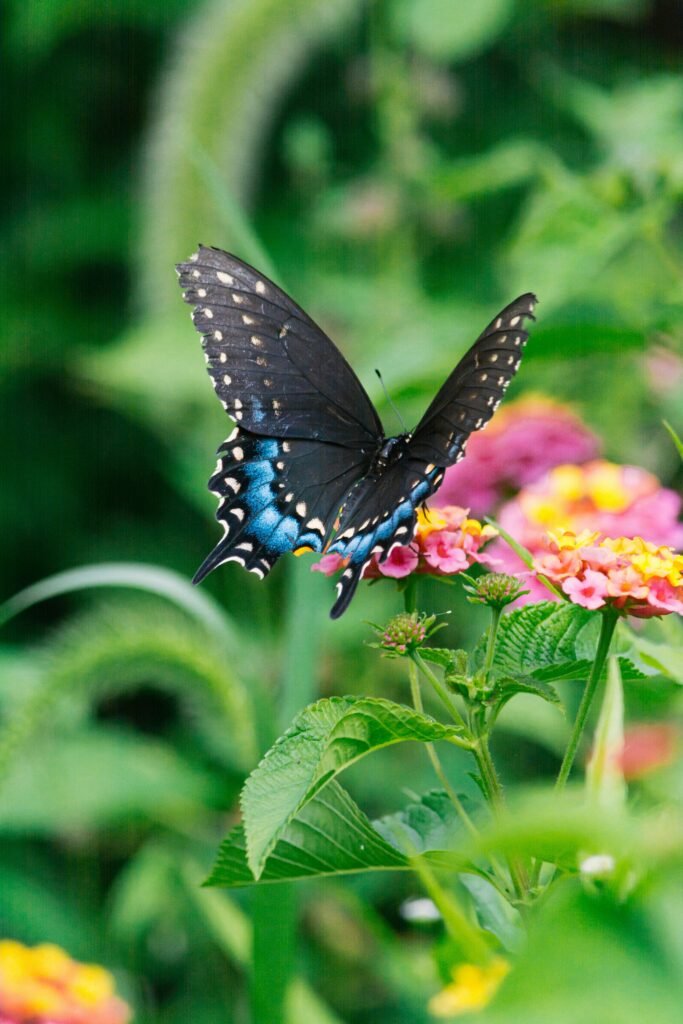
The forest margins around Pidurangala are home to a remarkable range of butterfly species that drift in and out of the Jungle Hideaway’s garden throughout the day. Lantana camara has been planted extensively along the garden’s sunny edges, its dense flower clusters shifting through yellow, orange, and pink as the season progresses — a continuous and generous nectar source that draws Common Mormon, Lime Butterfly, and Blue Tiger from the surrounding scrub and forest. By mid-morning, the Lantana borders are rarely still.
Passion Flower vines climb with characteristic enthusiasm along the trellises and boundary fences, their extraordinary blooms a counterpoint to the rugged rock landscape beyond. Their deeply lobed leaves serve as larval host plants for the Tawny Coster — one of the Jungle Hideaway’s most frequently encountered butterflies, its burnt-orange wings vivid against the green. Caterpillars on the vines are a welcome sight, proof that the garden is functioning as a complete habitat rather than merely a feeding station.
Crotalaria retusa grows in scattered clumps through the garden’s open, sun-warmed patches, its yellow flowers modest but ecologically important. In the dry-zone light that filters through the canopy near Pidurangala, it attracts Danaid species — Plain Tiger, Dark Blue Tiger — whose slow, deliberate flight through the garden feels almost ceremonial, as unhurried as the ancient rock that watches over it all.
Wild Haven — Stream, Lily Ponds, and the Shadow of Sigiriya
Nestled near the ancient rock fortress of Sigiriya, in the dry zone heartland of Sri Lanka, Wild Haven sits within a landscape of extraordinary stillness. A stream threads through the property boundary, and two lily ponds — serene, reflective, and alive with the quiet industry of dragonflies and waterbirds — give the garden its most distinctive character. It is a place where water, light, and greenery compose themselves into something that feels less designed than discovered.
The lily ponds are central to Wild Haven’s butterfly story in ways that go beyond the obvious. Water attracts insects, and insects attract butterflies — both as a resource and as an ecological anchor. The moist, sheltered microclimate around the ponds creates ideal conditions for species that favour humid, semi-shaded environments. Passion Flower vines planted along the pond margins provide larval habitat for the Tawny Coster, whose caterpillars can often be spotted on the leaves in the early morning, before the heat of the day sets in.
Ixora has been planted in generous groupings throughout the garden, its warm scarlet and coral blooms offering reliable nectar across much of the year. In the dry-zone light — sharper and more intense than the filtered green of the wet zone — Ixora’s colours seem to deepen, and the butterflies that work its flowers do so with an unhurried confidence. Grass Yellows, Psyches, and Emigrants move between the blooms in gentle, looping circuits.
Lantana borders frame the wilder edges of the garden, where the cultivated planting gives way to the dry scrub and scattered trees of the surrounding landscape. By mid-morning, these borders are alive with movement — Common Mormons, Lime Butterflies, and Blue Tigers nectaring alongside one another in the warm Sigiriya light. The stream beyond murmurs through it all, a quiet constant beneath the flutter and the bloom.
Wellness Retreat Kahandamodara — Lagoon, Beach, and Bloom
The Wellness Retreat at Kahandamodara occupies one of Sri Lanka’s most quietly spectacular settings: directly in front of the Kahandamodara Lagoon, with the beach just steps away. The air here carries both salt and the sweetness of flowering plants; the light is coastal — wide, generous, and luminous in the early morning and late afternoon. It is a place where the boundaries between land, water, and sky dissolve, and where the butterfly garden has been designed to feel as natural and inevitable as the landscape itself.
The lagoon and its surrounding vegetation create a rich ecological edge — the kind of transitional habitat where biodiversity concentrates and where butterfly species from both the coastal scrub and the more sheltered inland garden come together. Ixora, planted in warm drifts along the garden borders, provides year-round nectar and brings a richness of colour that holds its own against the blue of lagoon and sea beyond. Its compact form suits the coastal setting perfectly, tolerating the salt-laced breeze with ease.
Lantana spreads along the garden’s sunnier reaches, drawing nectaring butterflies through the warmth of the day. In the lagoon-side light, the wings of species like the Common Emigrant and the Psyche catch a particular luminosity — a shimmer of white and yellow that seems to echo the glint of water just beyond the garden boundary. Passion Flower vines drape the pergolas and garden structures, their complex blooms inviting slow, close attention — the kind of looking that a wellness retreat is made for.
Crotalaria retusa is tucked into the wilder corners of the garden, where it seeds itself freely and softens the line between the cultivated and the untamed. Its rattling pods become a sound of the garden — gentle, spontaneous, at home in the sea breeze. Guests at the retreat often find that the butterfly garden, with the lagoon shimmering just beyond and the distant sound of the surf, offers a quality of restoration that no formal programme can quite replicate. To sit still long enough for a butterfly to land is, in itself, a kind of healing.
The Plants Behind the Magic
The butterfly gardens across all three Back of Beyond properties share a core palette of four key species, each selected for its specific role in supporting butterfly life cycles:
Lantana camara — The Nectar Powerhouse
A prolific and long-flowering nectar plant, Lantana is arguably the single most effective butterfly-attracting plant available in Sri Lanka’s climate. Its compound flower heads, which change colour from yellow to orange to pink as individual florets mature, provide a continuous and varied nectar supply. It is particularly effective for Common Mormon, Lime Butterfly, Blue Tiger, and a wide range of skippers and whites.
Ixora coccinea — The Year-Round Bloomer
Native to Sri Lanka and widely loved in traditional gardens, Ixora is a compact, reliable, and ecologically valuable shrub. Its dense, globe-shaped flower clusters bloom almost continuously, making it an indispensable anchor for any butterfly garden. It is especially favoured by smaller species and is perfectly suited to the coastal conditions at Wild Haven.
Passiflora (Passion Flower) — The Life-Cycle Plant
More than a nectar source, Passion Flower is a host plant — one on which butterflies lay their eggs and caterpillars develop. Several species, including the Tawny Coster, are almost entirely dependent on Passiflora during their larval stage. Its vigorous climbing habit makes it ideal for fences, trellises, and walls, allowing it to be incorporated even into spaces with limited ground planting area.
Crotalaria retusa — The Conservation Plant
The rattlepod is a semi-wild flowering herb with a deceptively important ecological role. Rich in pyrrolizidine alkaloids, it is a preferred host and nectar plant for Danaid butterflies — species such as the Plain Tiger, Dark Blue Tiger, and Danaid Eggfly — which sequester these compounds as chemical defences against predators. Its presence in a garden signals a commitment to supporting the full spectrum of butterfly species, not merely the most visible ones.
Beyond the Properties: Taking the Corridor to Colombo
Back of Beyond’s commitment to butterflies does not end at the gates of its retreats. Inspired by what has been achieved at the Jungle Hideaway, Wild Haven, and Kahandamodara, the company has extended its butterfly planting initiative into the urban landscape of Colombo — a city that, despite its density, holds surprising potential for ecological restoration.
The urban butterfly corridor project has gained early momentum in some of Colombo’s most prominent locations. Around the BMICH complex and in the greened stretches near the British High Commission and the surrounding diplomatic and residential precinct, butterfly-friendly planting has been introduced — quietly transforming ornamental verges and underutilised green patches into productive ecological waypoints.
The same four plants that anchor the property gardens — Lantana, Ixora, Passion Flower, and Crotalaria retusa — form the backbone of the Colombo plantings, chosen for their proven performance, their suitability to the urban environment, and their ease of propagation and maintenance.
The vision is one of connectivity. A butterfly garden at Wild Haven, a corridor of Lantana along a Colombo roadside, a Passion Flower vine on an apartment balcony in Kollupitiya — each is a node in a network. Connect enough nodes and you create a living infrastructure through which butterflies, and the ecological processes they sustain, can move across an entire city.
Key locations where the initiative is already underway:
- BMICH grounds and surrounding parkland — butterfly planting established along key borders and open lawn edges
- British High Commission vicinity — native flowering shrubs introduced to roadside and boundary plantings
- Nearby residential and diplomatic areas — community-level participation in balcony and courtyard gardens
An Invitation to the Wild, Wherever You Are
Whether you encounter a Tawny Coster drifting through the Jungle Hideaway at dusk, watch a Blue Tiger circle the Ixora borders at Wild Haven, or sit quietly in the Kahandamodara garden while a Plain Tiger works the Crotalaria flowers with methodical patience — the experience is the same at its core: a moment of connection with something unhurried, unmanaged, and entirely alive.
Back of Beyond has always understood that the most meaningful hospitality is the kind that gives guests not just comfort, but contact with the natural world. The butterfly gardens are an expression of that belief — a commitment to sharing not just spaces, but the living richness that makes those spaces worth returning to.
And in Colombo, the invitation extends further still. You do not need a jungle to have a butterfly garden. You need a few plants, a little patience, and the knowledge that every flower you plant is a small act of restoration — one wing-beat at a time.
Experience It For Yourself
Jungle Hideaway · Wild Haven · Wellness Retreat Kahandamodara
www.backofbeyond.lk